
Work / 01
CRONOS: Achieve Optimum Balance
An upcoming documentary on the CRONOS Framework — a biological and behavioral resilience strategy grounded in the interplay of Challenge and Recovery across the Relational, Occupational, and Nutritional domains for Operational Stability.
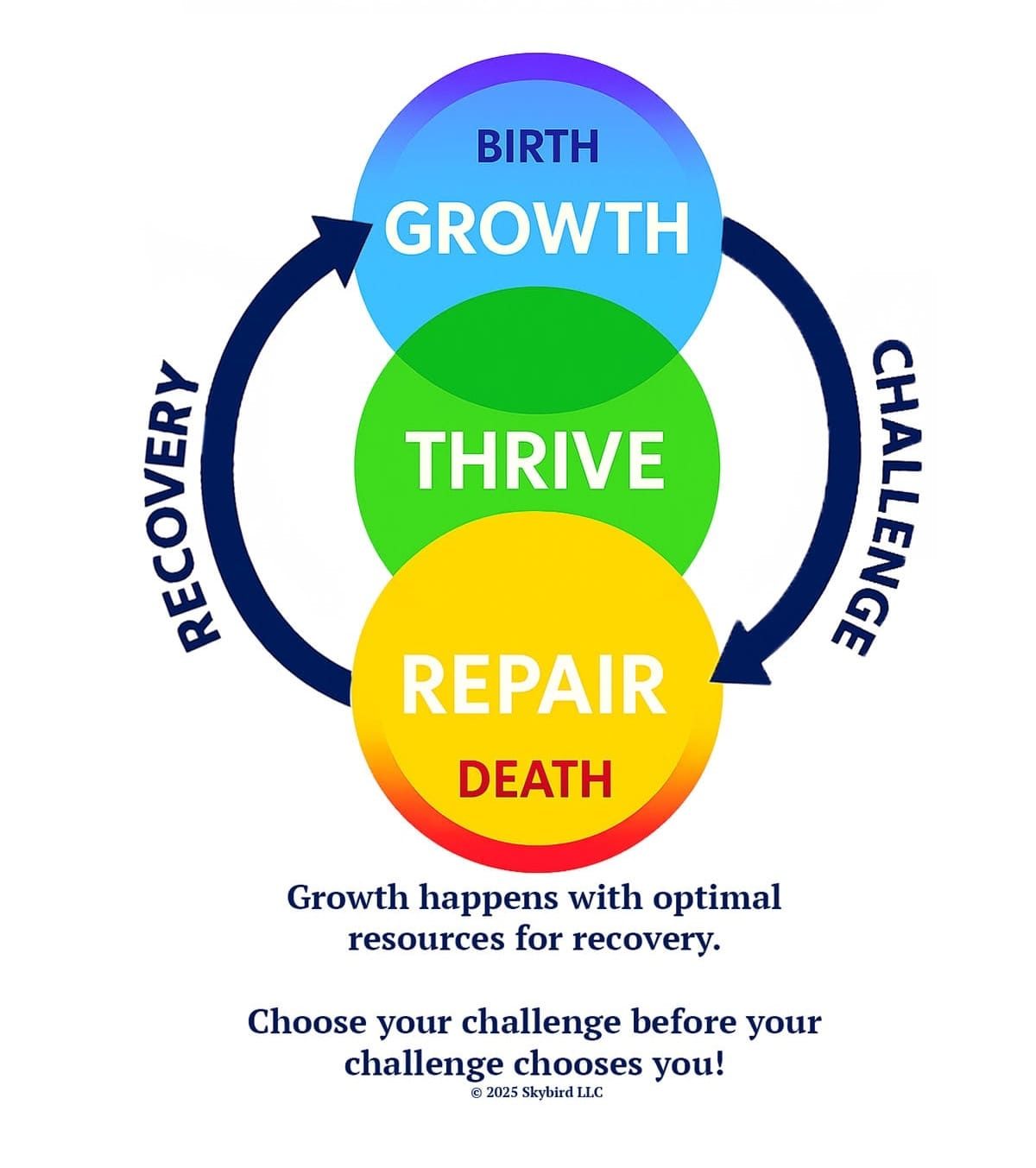


CRONOS: Achieve Optimum Balance is an upcoming documentary from Skybird Science Films. It brings together the CRONOS Framework and the Relational | CNS research behind it — how brains map people, places, and everything in between — into one film about resilience, allostasis, and everyday operational stability.
The CRONOS Framework is a biological and behavioral resilience strategy grounded in the interplay of Challenge and Recovery across the Relational, Occupational, and Nutritional domains for Operational Stability.
In experience and based on available research, we naturally go through stages of life that begin with exponential growth. Challenge and Recovery correspond to two branches of the peripheral nervous system: sympathetic and parasympathetic. Cycles occur for each of three domains of our outer world that impact our inner life — Relational, Occupational, and Nutritional — correlated with the central, peripheral, and enteric nervous systems, respectively. Voluntary challenge and deliberate recovery with optimal resources results in Operational Stability.
The CRONOS Framework
Small, steady improvements across all three life domains — Relational, Occupational, and Nutritional — build overall resilience.
Challenging ourselves is inherently voluntary; this triggers recovery, which increases our baseline. Our intent to challenge triggers our sympathetic nervous system. The input is our activity. The effects of the challenge trigger the underlying process of the parasympathetic nervous system, and the resulting output is greater resilience. It is easier on the body to do this by choice than by circumstance; thus the stress is perceived as beneficial.
In order to thrive, we must choose our challenges before our challenges choose us. Recovery improves with the right resources for recovery.
Of course, all this is governed by the somatic nervous system, which is the Relational | CNS, but for simplicity we focus on how we can apply this basic physiological feedback loop for our benefit.
The CRONOS Framework is based on multiple lines of evidence in physiology and neuroscience. The biological principle of allostasis shows that stability is achieved through change.
Choose your challenge: the cycle of voluntary challenges while ensuring adequate recovery ensures people can harness the body’s natural adaptive mechanisms. Any challenge to our thinking and feeling will naturally create a sense of stress; it is perceived the same as physical stress, like exercise. So we can expand our comfort zone to create change incrementally — including when we challenge ourselves to expand and deepen our social circle, focusing on our greatest and most important relationships, to strengthen them.
Relational | CNS
Before applying the principles of the Relational Domain, it helps to clarify what Relational means in the CRONOS Framework.
Although the English word Relational may be associated with social relationships, Relational, in the CRONOS Framework, defines our ability to relate — not just to people, but to places, possessions, and perspectives in time: everything we know, everyone we know, everywhere we spend time, and everything we have, both past and present; our identity, personality, principles, and patterns of knowledge and behavior.
We create experiences, which develops our foresight. We make choices, which increase the probability they will occur. We collect things, which occupy space in our mind. We make commitments, which take our attention. We learn concepts, which deepen with experience.
Whatever information we take in was encoded in some form by another intelligent entity — cave paintings, scrolls in clay jars, phone-tree prompts, instruction manuals, audiobooks, films, and TikTok duets. We express ourselves in music, poetry, body language, painting, and recording. The sum total of our outer world is modeled in our mind like layers of fabric, stitched together over the course of time, starting from before we emerge from the womb until they unravel in our final moments of life.
Neural networks, mental models, reference frames, mindsets, paradigms, and other terms refer to the same phenomenon: how the information is stored. Patterns are not necessarily in one location in the brain; all patterns are connected to some degree or another. The emotional aspects are encoded via the hippocampus and amygdala, then resurface when we least expect it. We learn, remember, express, and communicate.
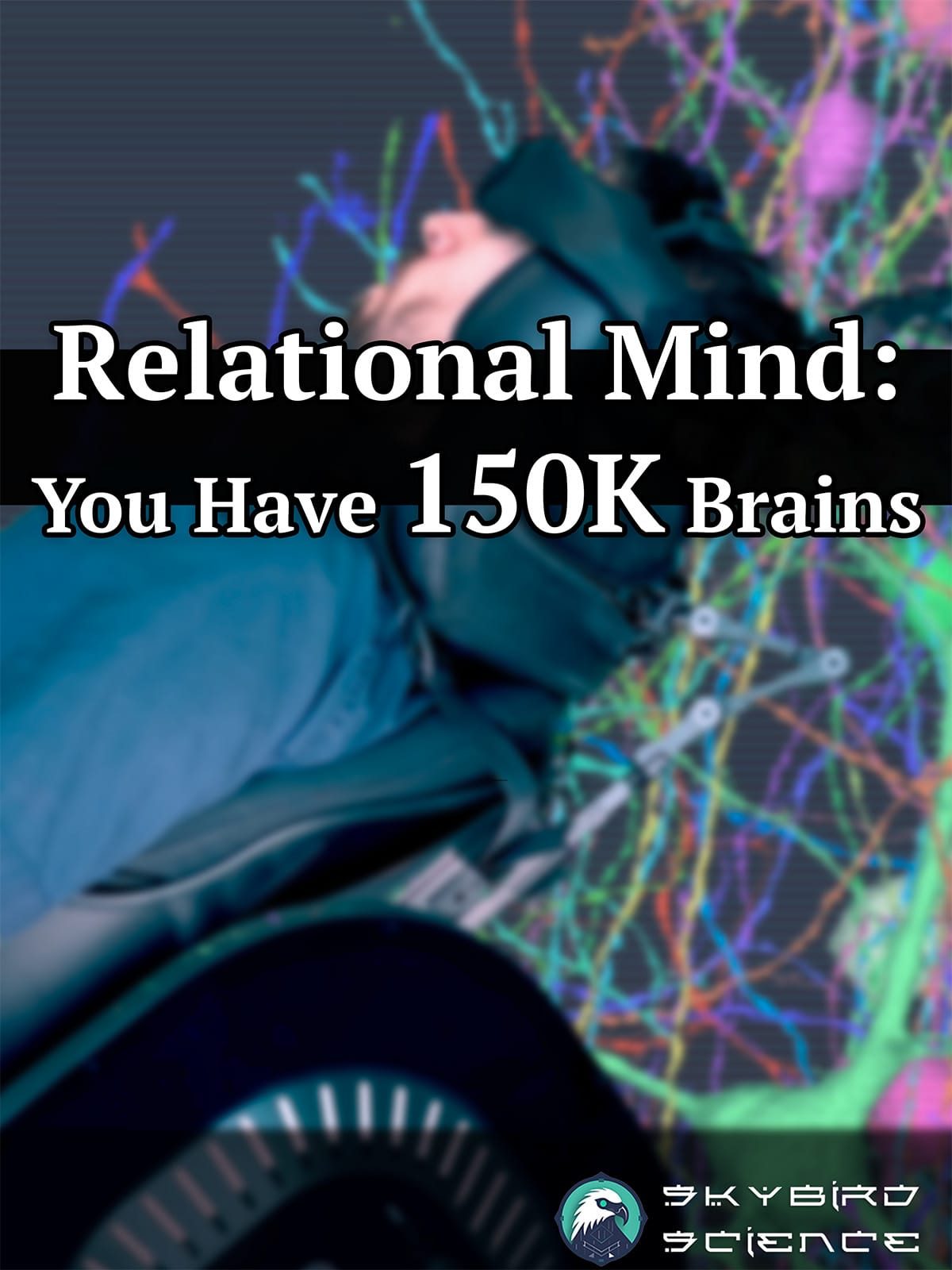
Neural Mechanisms of Relational Mapping
Our brains continuously weave these threads into an internal map of the external world, allowing us to relate to people, places, and possessions in a structured way. At the core of this mapping are cortical columns — vertical networks of neurons in the neocortex that serve as independent modeling units, a bit like spools of thread. Each cortical column learns predictive models of our outside world by integrating sensory inputs over time. Neurons within a column form an ongoing simulation of what we expect to perceive next.
Imagine picking up a coffee cup in a black box. Each touch provides a clue. Then the brain’s columns predict what you will feel at the next touch. This is how the brain models objects and environments through movement, gradually converging on a stable representation of “cup.” The same cortical circuitry operates in vision, hearing, and all other senses — implying the same way of processing information is used to learn any pattern.
According to the Thousand Brains Theory of Intelligence, we have thousands of models working in parallel across cortical columns. Each column builds its own model using reference frames — internal coordinate systems for representing the location of sensory features relative to an object or concept.
Every column is like an observer with a slightly different viewpoint. Our perception emerges from the consensus of these many parallel models. This massively redundant architecture explains why the human neocortex (with roughly 150,000 cortical columns) excels at recognition — even if some inputs are missing or ambiguous, enough columns can still piece together the puzzle.
Questions of Impact
The documentary explores practical questions that follow from Relational | CNS — how we relate to people, media, possessions, commitments, places, persona, and patterns.
- Who are the people we need to learn from the most? What relationships are we neglecting? What are the things we value? When are we at our best?
- What kinds of media do we consume, and what influence do these have on us? What do we need to learn? What do we want to unlearn?
- What things do we have to get rid of, what things do we need? How do we reduce the drag that clutter claims on our consciousness?
- What promises have we made? What open loops do we need to close? Which commitments are we not giving our full attention to, and which ones are pulling us away from the ones that matter most?
- How do the places we have access to transform our state of consciousness — clarity or confusion, serenity or stalemate, stimulation or stagnation? Where can we go so we feel at our best, and how would that experience transfer into everyday life?
- How does our persona affect our perception? How can we align our cognitive preferences with our daily activities?
- What patterns have we inherited or unconsciously acquired? What new patterns do we want to make? How can we repattern our behavior and our mindset?
Weekly Workflow Preview
CRONOS Protocol is an operational framework for stability. Intentional challenge and deliberate recovery form a blueprint for enhancing human performance and health. A weekly workflow preview from the framework:
- Log challenge and recovery inputs for each domain (scale each from 0 to 10).
- Update status scores (S) using check-ins or diagnostics.
- Assign urgency weights (w) to highlight this week’s priorities.
- Calculate OS score.
- Focus on the domain with the lowest Td value. Choose one micro-habit to move the needle.
- Repeat weekly. Small, consistent gains across all three domains lead to sustained and stable growth.
Start a project
Following this documentary?
Tell us what you want to see explored — science consulting, worldbuilding, or a hard-science pass for your own project.